“I’m depressed and my family tells me I’m lazy.” Help is on the way for your family. There is a special group for them.

Dep-Anon, a 12 step Recovery program for Families and Friends of the Depressed, is now being formed here (US) and other places where Depressed Anonymous is active.

Here is a passage from A Medley of Depression Stories where the author, a member of Depressed Anonymous, provides us with positive guidance. She tells us that.

“Depression is not my fault and your depression is not your fault. God knows we have been beaten up enough over being depressed and not being able to “suit up and show up!” Blaming the person with depression is harsh and cruel Would they blame a cancer victim? It has always amazed me that when it comes to mental illnesses, it is so often judged harshly. As though it’s one’s fault that they were sick or had a breakdown. It reminds me of people screaming at an alcoholic who has lost his job, but his family and lost his house! Exactly what good will come from that? Often loved ones think they are helping “pound some truth” j their alcoholic husband or wife’s head! If we just scream enough and say the most hateful and derogatory things then they will stop drinking and ” wake up” to their poor behavior.” Medley, p.73).

Writing Dep-Anon is why I feel a pressing concern, organizing and helping families of the depressed understand the nature of depression, what it is and what it is not. The family of the depressed needs to fix themselves and not try to fix something in their loved one which they knew little or nothing. From reading the above quote, we can feel the anger directed at those who were depressed.

The Dep-Anon family group uses the same 12 steps for family members who gather together, forming their groups helping each other learn the best ways to help themselves and deal with their issues instead of trying to change their depressed loved ones. The Dep-Anon manual provides a forum where family members can share their strengths, experiences with each other.

The Dep-Anon family group and the depressed have a symbiotic relationship in which each group is helped by the need to be addressed so there may be unity and healing. Dep-Anon provides a resource of discussion points and a commentary on the 12 steps for reflection and group discussions.
Support for the Family is indispensable.

“But for us the person is not a mere patient with specific depressive symptoms- he or she is family. They suffer, but they do not know what is happening to them, they make others suffer, and everybody feels abandoned because the DSO (depressed significant other) seems to prefer not to have anything to do with their family. When this occurs, family and friends withdraw, feeling the hurt of rejection. The DSO continues to be sad, unable to define the reason for this.” Dep-Anon. 2021.

RESOURCES

Smith, Hugh. Dep-Anon. A 12-step recovery program for families and friends of the depressed, recently published by Depressed Anonymous Publications. Louisville. 2021

This newly published work can be ordered online from the Depressed Anonymous Bookstore at this site. Visit the Store.

A website will be available in the coming month with its email address and information about upcoming Zoom and Skype meetings. We will continue to help you stay connected with info concerning Dep-Annon happenings online and f2f.

Hugh S.
Fear

I must not fear. Fear is the mind-killer. Fear is the little-death that brings total obliteration. I will face my fear. I will permit it to pass over me and through me. And when it has gone past I will turn the inner eye to see its path. Where the fear has gone there will be nothing. Only I will remain.
Frank Herbert, Dune

I recently watched the film Dune and was struck by this mantra given in the first half of the movie. Most of my fears are imaginations or are irrational. Is it rational to be afraid of being attacked by a tiger on the streets of New York City? No, that is definitely not rational. If however, I was walking in the jungles of India, at dusk, then it is a rational fear for me to have.

I must separate the rational from the irrational – the true from the imagined. If the fear is irrational then I need to focus on the reality of the present moment. Where am I? What am I feeling emotionally? Is it helpful for me to act out of that place of irrational fear? No, it is not helpful for me to act from that place of imagined fear.

What about facing rational and true fears? Courage is not having no fear, but rather facing your fear and acting anyway. If you truly do have to walk in the jungles of India at dusk, wear a backwards facing mask as that greatly diminishes the chances of a tiger attack.

Ask yourself “what can I do, in this moment, to protect myself from this true and rational fear?” Don’t give into the fear. Choose to act from a place of serenity and calm. You’ll be amazed at the results you will see.

Yours in recovery, Bill R

You get what you want by releasing. – Lester Levenson

How is that for a paradox? How can you get something by letting it go? Is there a problem here that we don’t understand? Most times we figure that only when we hold tightly to something WHICH we desire, it will be given to us. This does seem to be a little “off the wall” type of thinking but let’s take a deeper look into this statement.

The best way to hold a handful of sand in your hands is to just let the sand grains sit there. They are just there – much at peace with each other. But when you start to squeeze your hands and tighten your grip on the sand-what happens? You guessed it. The sand begins to move out through the fingers with pressure forcing them out through and off the hand.

Here is my take on this matter. In the real world of thinking, feeling, and behaving my own reflections tell me that the more you persist in doing something your way, the more resistance may begin to counteract your choice. It’s much like tightening a bolt just one more turn and guess what? The bolt breaks. Too tight.

In the spiritual world, so I have learned, is that when I let go, let God work out its will in my life, that what I want begins to be released for me. As it is said in the Promises of Depressed Anonymous that this new me, waiting instead of rushing, I find what I release eventually comes to me.

We will suddenly realize that God is doing for us what we could not do for ourselves. sometimes quickly, sometimes slowly. “Are these extravagant promises?” We think not. They will always materialize if we work for them.

Resource

Depressed Anonymous 3rd Edition, © 2011, Depressed Anonymous Publications, Louisville KY.

Pushing through!

When we talk about “pushing through” it indicates that there is special energy needed to complete a project or work through or push through a difficult and resistant obstacle. What is happening here is a lack of will.

In our work, “I’ll do it when I feel better” it is only when I am assured of being able to push through the obstacle that I will do it. The problem here is what we all know and have experienced in our own recovery is that we never feel better. And so, it doesn’t get done.

And so “Pushing through” is when we feel that we cannot move our body or motivate our will to “push through” an obstacle that keeps us from doing what we know we need to do. Why? Because we have been immobilized by the lack of will and/or motivation due to our depression and frozen will. These obstacles seem too high and too large to jump over, go around, or push through.
So, my best chance to push through to the other side, and accomplish what I need to do, is to take one small step at a time. The following are some ways to “push through” and get ourselves moving again.

As Stacy S, pointed out here in her excellent post Willingness to Take Baby Steps she tells us the importance of taking small baby steps. Please take a look.

I also would like to share some small things that we can do to get moving on and past those blocks to our motivation and recovery. We can say the Serenity Prayer slowly and with attention, read a paragraph from Higher Thoughts for Down Days, call a Depressed Anonymous friend or sponsor, walk outside for five minutes, and getting fresh air. Also, remember, there are two times that you should go to a Depressed Anonymous meeting; 1. When you want to go, and 2., When you don’t want to go.
We need to move the body and gently move forward and continue along in our recovery pushing on and through. Just do it!!!!

Hugh, for the Fellowship

When we are disturbed, something is wrong with us

It is a spiritual axiom that every time we are disturbed, no matter what the cause, there is something wrong with us. If somebody hurts us and we are sore, we are in the wrong also. But are there no exceptions to this rule? What about “justifiable” anger? If somebody cheats us, aren’t we entitled to be mad? Can’t we be properly angry with self-righteous folk? For us of A.A. these are dangerous exceptions. We have found that justified anger ought to be left to those better qualified to handle it.
Twelves Steps and Twelve Traditions, page 90

I need to remember that if I’m disturbed with something or someone I need to look within a see what is wrong with me. How am I thinking about my current situation? Is my thinking mature, serene, and sound regarding this circumstance? Am I looking to see where I’ve fallen short?

I say these things not as another opportunity to beat myself up but rather as a point of reflection. Is there anything that I could do that would be better than how I handled it before?

Improvement is possible only if I can recognize how things actually are and not how I think they should be. Accepting my part in my circumstance is the place from which I can grow and become better.

Could I give in to justifiable anger? Of course I could but would that be helpful and useful? Not very likely. It is far better for me to examine where I fell short, where I’m upset because that sticking point is where growth can occur. Have the courage to look within. It may be scary to look within, but that is where healing occurs. Good luck on your trip within.

Yours in recovery, Bill R

Metaphor for my depression

OK, I’m acknowledging and admitting in public that I have depression. I choose not to say that I suffer from depression, as I believe suffering is a choice. Here I mean the Buddhist interpretation of suffering, the mental and emotional anguish that we put ourselves through when we don’t accept the present moment for what it is.

Pain is part of the human experience, suffering is optional.

I choose to say instead that I have depression, or that I sometimes experience the symptoms of depression. This simple change of the words I use to describe my condition allows for space for the possibility that someday I won’t have depression, or that I don’t experience the symptoms of depression.

Why all this talk about words? Well words have great power. If you read Genesis, God first spoke “Let there be light”, then light existed. Words are the first step of creation. The words I choose to use help create my reality.

Many of us view life as a series of metaphors. Some view life as a race, others view it as a game, still others see it as a constant struggle. What metaphor do I use to describe my depression?


As I mentioned in a prior post, humans are dualistic beings. I see myself as two beings in one:

  1. a wounded inner child
  2. a mature outer adult

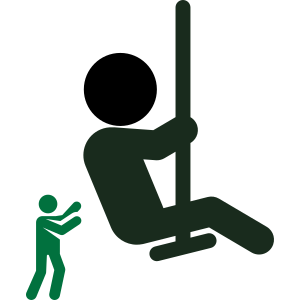
My depression shows itself by a lack of energy, a lack of progress, and a lack of emotion. The swing is not moving.

The depression is a manifestation of my wounded inner child. It is sitting in the swing. It is petulent and drags its feet in the sand. Sometimes it goes so far as to pump its legs in the opposite direction to prevent progress.

My outer mature adult is smaller than the depression. I can’t give a single push to get the depression swinging. I have to time my pushes, and consistently apply positive actions in my life. I have to encourage the inner child to lift his feet. After that I can encourage the inner child to begin pumping his legs so swinging isn’t relying totally on my smaller outer self.

It’s not a perfect metaphor mind you, but it is fairly consistent with my experience with my depression. I am hopeful that consistently giving gentle pushes I will emerge from the depression, free and happy once again. This future is possible for you too.

Yours in recovery, Bill R

We can start today in getting our lives in order

It is only when we have begun to experience the sanity and healing of the program, studying the Steps and then returning to the meetings week after week, it is then, and only then, that we have the desire to want to bring this message of hope to those still suffering. Too often those who are hurting the most have the least desire to stick out the weekly meetings and which can produce a belief that they will be healed. They just don’t believe that anything good can happen to them. This of course is where they make a mistake. Their depression continues to inform them that no matter what they do or the actions that they take on their own behalf, it seems that nothing provides relief. I remember the times I informed two gentlemen, each at different times within a two-week period to come to our program and give it a try to see if they might begin to feel differently. I told them most, if not all those who come to our group, almost always felt better after getting actively involved in our program. They both declined my invitation. Within the next month, both had completed suicide. They chose death over the possibility of life. One of the recently deceased told me what would he gain by going to a meeting with a bunch of depressed people? Wasn’t he depressed enough? In a sense he was right. If a depressed person goes to a Depressed Anonymous meeting and they just talk about their depression, then yes, I suppose that would bring on more sadness in a person. But if it is a Depressed Anonymous meeting where they speak about the spiritual nature of the program and begin to live out the solution. namely, all that is contained in the suggested principles in the 12 Steps then they will definitely get the help they need. We live in the solution, not the problem. If you go to one of our meetings and hear nothing but talk of depression and nothing about the spirituality of our program of recovery that you might be in the wrong meeting. The good thing about the Depressed Anonymous meeting is that many of those attending are in that stage of their recovery, have a sponsor, have been applying the tools of the program, and have gained a positive view of themselves, their world, and their future.

Those of us who have lived with depression on a daily basis know the despair that dogs us day after day. For those who have been dependent principally on drugs and therapy and found no relief -this program is a good place to land. For those who have the courage to stay, and that need help, then this personal faith and effort will begin to pay off in time.

RESOURCE
Copyright(c) Hugh Smith. Depressed Once – Not Twice. (2000) Depressed Anonymous Publications. Louisville, Ky. Pages 1-2.

Powered Up!

Powered up can mean a countless number of things to a lot of different people. It means that by involving myself in certain activities, I benefit from moving on to what I know is vital for me. Necessary in the sense of staying fit and healthy (walking, weight training), I get myself powered up to do what I want to do. For the athlete, or musician, writer, songwriter, and others, we all get powered up by doing whatever is needed to be the best we can be. When this happens, we feel powered up.

As a member of the Depressed Anonymous Fellowship, I am powered up when I involve myself in positive and healthy daily activities. This means that I am open and willing to do all that it takes to get myself undepressed, maintaining a daily regimen for my recovery.

Here is a formula for getting yourself powered up.

  1. I do positive self-talk. I no longer fall into the trap of self-bashing. I produce “sunspots (memories, pictures) in my mind” that keep me positive.
  2. I walk as often as I can when I can. Usually, three times a week.
  3. I pray and meditate daily and keep in touch with my Higher Power – having conscious contact with my God.
  4. Social engagement. I keep going to my Depressed Anonymous meetings, whether online or face to face. This is a must! Meetings energize me and motivate me always to want to come back.
  5. Exercise keeps me powered up. I feel energized, and I feel in harmony when I am in nature. Go green!!! Nature has a calming effect on me.
  6. Staying in the NOW. Practice mindfulness.
  7. Serve as a co-sponsor for a member of our fellowship. Call a friend when in need. Meet with members between meetings.
  8. Read Depressed Anonymous literature.
  9. Eat a healthy plant-based diet.
  10. Play. Have fun.

Hugh, for the fellowship

I still prefer to cling to the so-called illusion of religion. – Bill W., co-founder of AA

Bill W., the co-founder of Alcoholics Anonymous, wrote this to a friend in 1946, sharing this thought:

Many people soberly assure me that man has no more place in the universe than that of another competing organism, fighting its way through life only to perish in the end. Hearing this, I feel that I still prefer to cling to the so-called illusion of religion, which in my own experience has meaningfully told me something very different.

REFERENCE
Copyright(c) As Bill Sees It: The A.A. Way of Life – Selected Writings of A. A’s co-founder. Alcoholics Anonymous World Services, New York 1967. Page 137.

Fellowships creating communities of hope and mutual care for each other!

Sigmund Freud was once asked what people needed to be happy. The questioner no doubt expected a long, complicated answer reflecting Freud’s years of deep reflection on the matter. His simple response, however, was “arbeiten und lieben”, – work and love. Happy people feel connected to others at work and through their intimate relationships. When those connections are threatened and diminished or broken, people suffer. others at work and through their intimate relationships. When these connections are threatened and diminished, or broken, people suffer. Today, millions of Americans are Americans are suffering from what my colleague Charles Derber calls “double trouble.” Those in double trouble have neither meaningful work nor sustaining intimate ties. The withering community life in both domains fosters a rootlessness and social disintegration that unquestionably contributes to the growth of emotional disorders.
David Karp. Speaking of Sadness: Depression, Disconnection, and the Meanings of Illness. (1996) Oxford University Press. New York. Page 178

It has been my personal experience that for as many years that I have been involved with Depressed Anonymous and other 12 Step fellowships how vital community is for us who seek healing, help, and hope. It is such a strength that those of us who use the program and attend the meetings find we are part of a loving community. We are part of a community where others care about us and share with us, and then we become the “miracle of the group” for others.

Today in our world, our global depression is of pandemic proportions. There is no vaccination for depression, of which I am aware. But what we do have is each other. There we can form relationships with others just like ourselves. We can have a sponsor who can listen and share their own experiences with depression giving us hope. Indeed, and speaking metaphorically a shot in the arm. So, what the world needs now is for each of us, by our WORK and LOVE of each other, to thrive – not close ourselves off in isolation and despair. Our “home” group where we go every week, virtually or face-to-face, is in this context of fellowship that we are “rooted” and become a family of friends–not acquaintances.

I have friends that I first met in DA that go back thirty years or more. Depressed Anonymous means growth, community, and serenity.
Please join our fellowship and be part of an ever-growing and loving community worldwide. We are not alone!

Hope is just a few steps away!