Boundaries

Definition
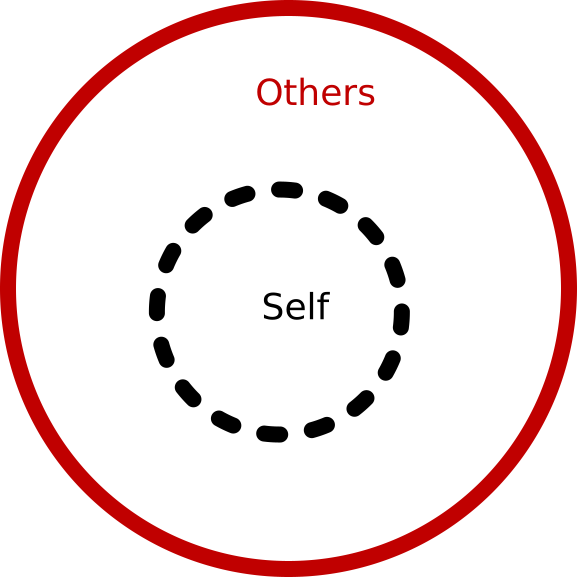
Boundaries are things that put a limit on something else. They clearly define the minimum or maximum. Boundaries define what is inside and what is outside. They delineate what is acceptable and what is not acceptable. Boundaries can be many things to many different people. In the context of recovery and self-growth, boundaries are put into place to control the poor behavior of people and to protect one from the other.

Boundaries can be healthy or unhealthy. They can be lovingly firm or manipulative and controlling. Healthy boundaries are lovingly firm and should protect you from the poor behavior of others.

Boundaries are not perfect, you may still get hurt, but hopefully the boundary has protected you from the gravest of harm.

Firm, but flexible

Boundaries should be firm yet flexible. You may have a firm boundary where people should not yell and curse in your presence, but it should be flexible enough to allow for a loud and profane interjection after your spouse hits their thumb with a hammer. It wouldn’t permit a non-stop cursing tirade after hammering the thumb, but an involuntary curse after the hit would be understandable.

Creating and maintaining flexible and healthy boundaries can be very difficult but it is well worth the effort. Below is an example of an unhealthy boundary as it is porous.

Unhealthy boundary

Two types of boundaries

  • Protective boundaries
  • Containment boundaries

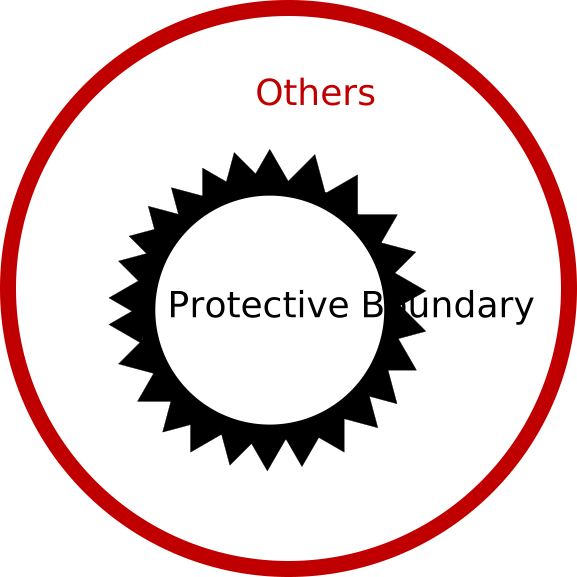
Protective boundaries are limits that I put into place to protect myself from the poor behavior of others. Protective boundaries can be put in place to prevent persistent yelling, or sarcasm, or any other poor behavior. Protective boundaries typically take the form:

When you do (specific-behavior), I will remind you of my boundary. If you continue to (specific-behavior) I will respond by doing (consequence-behavior).

For example:

When you raise your voice in anger to me I will calmly remind you of my boundary. If you continue to raise your voice in anger to me I will calmly leave the house and go for a walk or drive for between 15 minutes and an hour.

Protective boundary

Protective boundaries are not easy but they are necessary.

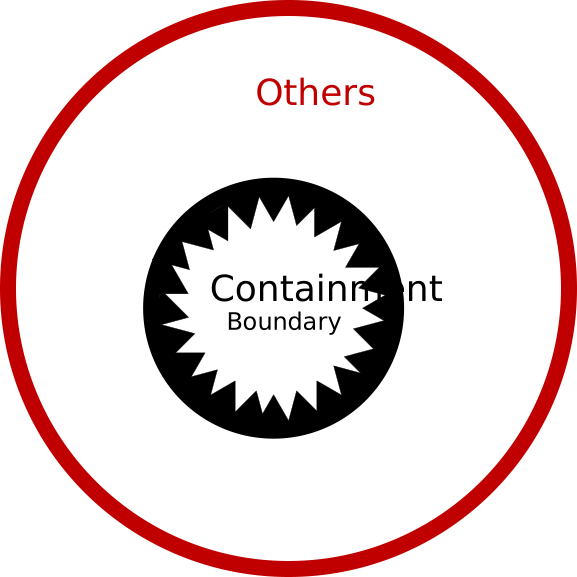
Containment boundaries are limits that I put into place to protect others from my poor behavior. You mean that I am not perfect? Containment boundaries typically take the form:

When you do (specific-behavior) I (feel-emotion/think-thought) and I will do (limiting-behavior).

For example:

When you talk on and on I think ‘will he ever shut up’, and I will not interrupt you but rather I will recite the serenity prayer in my head.

Containment boundary

Containment boundaries are also not easy, but they are just as necessary.
I would strongly suggest that for every protective boundary you have in place that you also create the corresponding containment boundary. For instance, if you do not want others to raise their voice in anger to you, then your containment boundary would be that you cannot raise your voice in anger to others.

Five categories of boundaries

  • Physical
  • Emotional
  • Mental
  • Social
  • Spiritual

Physical Boundaries
Some examples include:

  • Not being touched inappropriately;
  • Having private alone time;
  • Personal items not being used without permission;
  • Personal space;
  • Respecting locked doors to private space;
  • No extremely loud noises;

Emotional Boundaries
Some examples include:

  • Having a right sized emotional response;
  • Not being told we shouldn’t feel a certain way;
  • Denying your feelings;
  • Being given time to process emotions;
  • Having the courage to experience and sense emotions at depth;
  • No blaming others for your emotions which includes no talk of “you made me feel”;
  • Taking ownership and responsibility for your own emotions;

Mental Boundaries
Some examples include:

  • Not being called stupid;
  • Not being told your thoughts don’t matter;
  • Telling the truth, the whole truth, and nothing but the truth;
  • Listening with an open mind;
  • Not getting stuck in “stinking thinking” (Ego, Greed, Aversion, Delusion);
  • Holding onto your opinions and beliefs;
  • Respecting another persons opinions and beliefs;
  • If you must disagree with someone, then disagree with their line of thought, but not with them;

Social Boundaries
Some examples include:

  • Not condoning or participating in gossip;
  • Not lying or manipulating;
  • Following through on your commitments;
  • Being respectful of people’s time;
  • Having good manners;
  • Not accepting or condoning toxic behavior. Separating yourself from toxic people;
  • Speak directly to others, no triangulation. An example of triangulation: A has issue with B, A doesn’t talk to B, A talks to C, and A is hoping that C will talk to B on their behalf;
  • Following through with your plans if others don’t show up. Allowing others to go through with their plans if you don’t show up;

Spiritual Boundaries
Some examples include:

  • Not holding blindly on to your beliefs even though evidence points to something different;
  • Respecting the beliefs of others and not preaching at them they are wrong and your way is right;
  • Refusing to betray your moral values;
  • Being open to listen to others sharing their beliefs and looking for the common ground between your belief and theirs;
  • Letting go of the language of good and bad. These carry too much weight and people can take them on that they are inherently bad. Choose instead the language of helpful versus harmful;
  • Let go of judging others. If you must still judge someone then focus on their behavior and the words they speak. We can’t truly know another persons thoughts and emotions. That capability is outside of human hands, but rather in the hands of the Divine;

Boundaries – Parenting your inner child
Many people think of setting boundaries as controlling another person’s behavior. On the surface I would agree with that assessment. However, boundaries have a much deeper context.
Lying within all of us is our own wounded inner child. Face it, we are all broken in one way or another. Boundaries are really about parenting that inner wounded child.
Confronting someone who has violated your boundary sounds like a good thing to do. I would say that this is not always true. In the real world if your child was being bullied by another child you may want to swoop in there and punish the bully. The thing is that even bullies have parents. Confrontation is not always the best solution. Perhaps the best solution is to remove your child from the situation. The same holds true as we set boundaries as an adult. Our mature outer adult is defining what is and is not acceptable behavior and having an action plan that “if you do X” then “I will do Y”.

If you continue to speak to me in a loud and sarcastic way then I’m going to excuse myself and take myself (and my wounded inner child) out of harms way.

Confronting bad behavior can backfire. I would posit that perhaps you are trying to teach the inner wounded child of the bully what is and is not acceptable behavior. The thing is the perpetrator’s inner wounded child could be running the show for their outer adult, and that outer adult may have real power that may be able to harm you (physically, emotionally, financially, etc.).

Be a loving parent to your own inner wounded child. Keep them safe. Create an environment that is beneficial for their growth and healing.
Setting clear and mature boundaries will not only parent your own inner wounded child, but it will model good behavior and perhaps influence the inner wounded children of the people in your life. You can’t control other people, but you can influence them. Be the shining light of reason and serenity. Be loving but firm and protect your inner child’s environment.

Personal Stories: DA and Yoga proved a powerful combination …..

My family immigrated from Kharkiv, Ukraine to the USA in 1992 as refugees. When I came to the United States, it seemed like I came from another planet.  Everything was different: language, mentality, and environment.  It seemed like I lost my identity and I did not belong anywhere.  In New York, I went to college.  However, I became severely depressed during my second semester and was hospitalized for depression.  When I got better, I returned to college and obtained my BA in Liberal Arts and MS in Education.  I wanted to become an elementary school teacher but became interested in school psychology and became a school psychologist for New York City, Department of Education.  The job was so stressful that i was hospitalized for depression and finally quit the job and went on disability.

One day I saw a yoga studio near where I lived.  I didn’t know anything about yoga.  I absolutely loved yoga after the first session.  Yoga helped me tremendously with my depression.  I did yoga in the hospital for myself and the other patients and the nurses.  Then I promised to myself and to God (even though I am agnostic) that I will be teaching free yoga to anyone who wants to learn.

I always searched for a cure for my depression and felt the need of a support group in addition to my psychotherapy and medications, so I was happy when I found DA online.  My first DA meeting was on September 22, 2020.  It’s my first Twelve Step program and I decided to give it a chance.  I thought “I don’t have anything to lose except my misery.”  I was very skeptical at the beginning, because nothing seemed to help my depression.  I couldn’t share anything during my first DA meeting and didn’t have my camera on.  I didn’t purchase DA literature for about a month because I didn’t have money and wasn’t sure if DA would help me after everything I had been through.  To my surprise, after being in DA for two years, I felt I became less depressed.  I didn’t get hospitalized during this time, I made friends by attending daily DA meetings, I was reading DA literature, working the 12 Steps, got a sponsor and joined two co-sponsorship groups.   I found my purpose in life by sharing my story and offering yoga to DA members twice a week.  I still feel anxious and depressed  sometimes but I know that I can use the tools of DA, reach out to my sponsor and DA friends, and count on their support.  I can see a tremendous difference in myself.  In a sense, I “love my depression” now because through it I found the DA community and feel like I finally belong.  I am so grateful to be a DA member and I hope my hard work in DA and my Higher Power (power of DA group, yoga and universal love) will bring me peace and serenity, and I will be able to say one day that I am completely recovered from depression.

Irene S., NYC, October 2023

Depression is a process addiction

Depression is a process addiction, just as alcoholism is a substance addiction.

A process addiction is when a person is addicted to a particular behavior. When we speak about one addiction, like the process addiction of depression, we can include them all. We are learning that the Twelve Step program of recovery can be used to overcome negative thinking and compulsive/addictive behavior for the person who sincerely wants to get emotionally, physically and spiritually healthy.

Our Depressed Anonymous fellowship is based on a hope that no matter how bad we feel, no matter how isolated we are, or how painful we feel, we do recover.

We discover that all our negative thinking, feeling and behaviors will no longer keep us captive, isolated and in the prison of our depression. We gradually begin to change the way we think and feel, learning how to motivate ourselves, using the Spiritual principles of the Twelve Steps, and begin to get active in our own recovery. Motivation follows action!

The main positive effect of making the Steps an integral part of our daily Lives is that people can come together and find the support of their Depressed Anonymous fellowship. They in turn will find the emotional nurturing acceptance of their group and learn the social skills that can help them gradually enter life again; with hope and a heightened spirit. Once people realize that they are not alone and that they hope that they too will feel better. The beauty of a self-help group is that a person feels acceptance from the group. No one is there to tell them to “snap out of it” or that depression is all in your mind.

Finally, we see our closed system of depression, with its negative addictive thinking, feelings of despair, coupled with those behaviors which keep us afraid and anxious, gradually are being dismantled. We discover that we have choices. We don’t have to stay isolated. Our positive thinking begins to show us a way out of a system that has had us bullied into submission. Our minds are now processing hope and possibilities for a new life of freedom.

Hugh S., for the fellowship

Belief in myself

Depression is something that is so overwhelming. For myself it is like crawling from beneath the earth and facing the light, with fear
that no one would understand how I truly feel.

When in depression, isolation would follow, being my only friend, but actually it was my own worst enemy. I should have been opening up to someone, instead I shut myself off from the world.

Through therapy and a belief in myself and encouragement, facing the days didn’t seem so difficult.

Working on my Twelve Steps of Depressed Anonymous, and reading “Higher Thoughts for Down Days” gave me reassurance that we are not alone.

I now appreciate what I do have when I work through the program.
– Reatha, Canada

Who am I? What do I want? Who is my God?

As we dig  deeper into the  benefits of the Inventory, we want to get started with asking ourselves some  basic questions,

Who am I? What do I want ? Who is my God?

I  recommend  that you spend some time reflecting upon these questions as we continue our discussion of seeking more information on who we are  as a person.  This self-disclosure   process can provide us with  valuable insights as to those areas of our lives which have been responsible for the way  we are today. This includes an examination of the way we think, feel and  live out our daily lives.

In the early days of my own recovery, I  began to put together a workbook where I used  the three questions listed above and  focused on each of the Twelve Steps.   With each step, I listed a number of  questions which I felt would help  me discover  the areas in my life which I had never really examined  in any detail.  An important issue here is that when I was depressed  I didn’t have a clue as to what was happening to me.  I felt like my mind and body were spiraling down a slippery slope.

My first  reaction to this sudden fear was to create even more fear as my mind swirled around,  attempting  to  stop whatever it was that suddenly and without warning, had me locked in  a mental turmoil.  As I was oblivious to the fact that I had unconsciously and  gradually beat myself up over the previous months , creating guilt and shame,   resulting   that I became physically and emotionally immobilized.  Eventually , I discovered that this was called depression.

Back to our inventory. Only with the help of the newly formed Depressed Anonymous group,  a fellowship that was using the Twelve   Steps for their recovery.   It was when  I admitted that I was powerless over my depression, that the real work had  its beginning.

If you want to examine your  own life, with a personal  thumb print of your strengths and weakness,  then today is a good day to get started.

As an exercise in recovery,  write down your own responses to the three  questions listed in the   title of today’s blog .  Take your time, this is a marathon, not a sprint.  Again , we  are  taking  time out to find out who we are…not who people said we were.  It will not surprise you that what others said you were   in your early life, favorable or not,  stays with you into your teen years,  adult  life.

As we move along in our recovery, answering the questions in the workbook, gradually our examined life will provide you with information that you may  never have thought about.

So,  next time I meet with you  at our  blog, I hope you will have made a start in discovering something about yourself.  The inventory is about making progress–not being perfect.

The Depressed  Anonymous Workbook.  (Depressed Anonymous Publications. Louisville , Ky.

If  you have questions please let me know. My email address is: depanon@netpenny.net

The unexamined life

“The unexamined life may not be  worth living, but the unlived life is sure not worth living.”

As the publisher of books,  the taking of inventory of my product , is critical  for the success of my business.   When I got started in my  production of books I wasn’t  sure  of how  many books I would need for immediate sale on the market.  I decided x number of books would  be needed for immediate sale and would purchase more from the printer as needed.

I knew that as an order came in for the purchase of our books, I could get them to the customer in one week. The turn-around was quick. As more books were  sold, and my inventory became depleted, I had to rush to get more books printed (the turn-around  from the printer  was two weeks or more , and our shipping to the customer turned out to be three to four weeks). For us, that was unacceptable.  We made sure from that experience, to always have  an inventory available  to meet the growing demands for our books.

In our recovery program, Depressed Anonymous, in the Fourth Step, we  are asked to make an inventory. This inventory will help us meet the daily  demands of  our lives  as we begin to  examine  those  negative thoughts,  feelings,  with their crippling  behaviors, which have kept us imprisoned in  that  loop of helplessness and  hopelessness, spiraling us downward into the  pit  where we lost all hope,

In our ongoing posts on Step Four, we  will continue to examine Step F our, which states that  we have “Made a searching and fearless moral inventory of ourselves.”   

In the next days we will post reflections on our  own inventory and how our examinations will lead us to a life filled with hope.

Please join with me as we travel this road together.

Hugh., for the fellowship

The Recovery Waltz

When I find myself drifting back into the pit (which is where I am at the moment) I need to go back to the beginning of recovery. Steps 1, 2, 3 and repeat. One, two, three like the waltz. Lather, rinse, repeat.

The first 3 steps can be summed up as follows:

  1. I can’t.
  2. He can.
  3. Trust Him.

A great many things, including my depression, are beyond my direct control. I don’t control the outcome – that is in God’s hands. I am responsible for the legwork. I need to do the work of recovery. I want to do the work of recovery. I don’t want to drift closer to the pit because if I don’t stop the backslide it will be that much harder to get out of it.

  1. I admit that I am powerless over depression. When I am on autopilot my life becomes unmanageable.
  2. I believe that a Higher Power exists and they can restore me to sanity. I have to work on my feelings of being unworthy of being saved.
  3. I turn my life over to the care of my Higher Power. This is not one and done. I’m human and I will take my will back. That is only a problem if I don’t surrender once again. To surrender is to win.

Practice the recovery waltz. Become so accustomed to it that it becomes a good habit. You are worthy of love and healing, but you must do the work of the steps to feel that love and healing. I wish you well.

Yours in recovery, Bill R

Am I a victim?

The topic of victim hood has come up several times in different meetings I’ve attended. There is some toxic self help out there that states that no one is a victim. I firmly do not believe that statement.

Do people inflict pain upon one another? Yes they do, sometimes that hurt is intentional, and sometimes it is not intentional. So I believe that victims exist in the world.

The problem for us as depressed people is not that we have been victimized – the problem is when we identify as being a victim. A better question to ask is:

Have I been victimized? (notice past tense here)

It’s when we make being a victim as our main identity that it becomes a problem.

I choose NOT to say “I suffer from depression” because then I identify with suffering from depression. I’m not denying that I’m often visited by the symptoms of depression. What I choose to do is instead focus on healing and recovery. “I am recovering from depression” is a much better and healthier statement for me. It points me in the direction of healing and hope.

Focus on hope and healing as that is the way out of depression.

Yours in recovery, Bill R

Hope is just a few steps away!